
Leveraging the ISO 56000 family of standards for innovation excellence and competitiveness Europe...
Innovation is the engine of economic growth
Joel Mokyr, Philippe Aghion, and Peter Howitt were awarded the 2025 Nobel Memorial Prize in Economic Sciences for their groundbreaking research explaining how innovation activities drive long-term economic growth. Their combined work reveals that economic progress is not automatic; it depends on societies’ and organizations’ ability to generate, absorb, and manage new insights and ideas.
Innovation efforts have been a key force in lifting billions out of poverty and propelling prosperity for centuries, yet they remain fragile. The Nobel Committee warned that progress can stall if institutions, organizations, and policies fail to support innovation activities. This insight brings a clear message: innovation efforts must be systematically nurtured, not left to chance. The emerging discipline of systematic innovation management, codified in the international standard ISO 56001, provides precisely this framework.
The Nobel findings
Joel Mokyr traced the historical roots of innovation-led growth. His research shows that the Industrial Revolution became self-sustaining because people began to seek not just what works but why it works. Scientific understanding replaced trial and error, turning discovery into a cumulative process. Mokyr emphasized that open societies, where ideas circulate freely and old dogmas can be challenged, consistently out-innovated closed ones. In short, culture and knowledge networks are the foundation of enduring innovation efforts.
Philippe Aghion and Peter Howitt provided the analytical framework to explain how innovation translates into growth. Their “creative destruction” model demonstrated that economies grow when new innovations replace old ones. This constant renewal boosts productivity but also creates tension: incumbents may resist innovations that threaten their dominance. Hence, innovation-driven growth depends on maintaining competition, openness, and policies that favor new entrants and continuous renewal.
Together, Mokyr, Aghion, and Howitt show that innovating is not a random spark, it is a structured, self-reinforcing process that thrives under the right institutional, cultural, and managerial conditions. Sustained growth requires systematic innovation management at every level, from national to organizational levels.
ISO 56001 Innovation management system
The Nobel insights align perfectly with the logic of ISO 56001, the world’s first international and certifiable innovation management system standard. The standard defines the requirements for establishing and continually improving an organization’s innovation capability. Just as ISO 9001 professionalized quality management, ISO 56001 does the same for innovation activities, turning a vague aspiration into a structured capability.
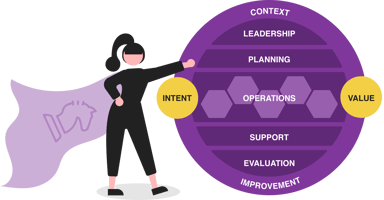
ISO 56001 promotes a systems approach: leadership, strategy, culture, competencies, collaboration, and learning are treated as interlinked components of innovation success. It ensures that innovation efforts are not an isolated, creative activity, but a set of managed processes that align with strategic objectives and yield measurable outcomes. Notably, the standard supports creativity rather than restricting it. The goal is to create the best possible conditions and remove barriers that enable innovation activities to flourish and deliver value.
Five recommendations for organizations
Organizations aiming to systematize innovation efforts can draw five key lessons from the Nobel research and ISO 56001:
First, treat innovation activities as a managed system, not an ad-hoc effort. Fragmented ideation events and pilot projects often fail to yield sustained results. Establish clear structures, roles, and processes, supported by regular evaluation and improvement cycles.
Second, build a culture of curiosity and openness. Leadership must champion innovation initiatives visibly, rewarding experimentation and learning from failure. As Mokyr showed, openness to new insights and ideas is the single most reliable driver of long-term creativity.
Third, align innovation activities with strategy. Innovation efforts should serve organizational goals, not exist independently of them. ISO 56001 requires linking innovation initiatives to strategic priorities, ensuring resources are sustained, and results are measurable.
Fourth, embrace uncertainty through disciplined experimentation. Innovation activities are inherently risky, but risk can be managed through structured experimentation, portfolio thinking, and adaptive learning. Failure should generate new knowledge, not fear.
Fifth, collaborate and connect. Innovation activities thrive in networks. Utilize common frameworks to facilitate collaboration across teams and partners. ISO 56001 enables joint innovation efforts by providing shared language and processes across value chains and ecosystems.
Three recommendations for policymakers
The Nobel findings underscore the role of public policy in enabling or hindering innovation-driven growth.
First, invest in knowledge and talent. Mokyr’s work demonstrates that progress is grounded in understanding. Governments must fund science, education, and open research while encouraging lifelong learning and global talent exchange.
Second, maintain open and competitive markets. Aghion and Howitt’s theory of creative destruction shows that innovation withers when incumbents are shielded. Regulators should preserve competition, reduce entry barriers, and resist protectionist pressures that hinder the emergence of new insights and ideas.
Third, steer innovation efforts through smart frameworks. Public funding and procurement should reward organizations that demonstrate structured innovation capabilities. ISO 56001 can serve as a benchmark for allocating grants or assessing innovation readiness. Governments can also establish ecosystems that connect academia, startups, and industry, while maintaining adaptive regulations that allow for experimentation.
Conclusion
The 2025 Nobel Memorial Prize affirms that innovation activities are the engine of progress, but must be managed deliberately. Mokyr explained how knowledge and openness ignite it; Aghion and Howitt showed how creative destruction sustains it. ISO 56001 translates these principles into practice by offering organizations and policymakers a structured way to turn innovation efforts from aspiration into a managed system.
Innovation management is not bureaucracy; it is a responsibility. In a time of rapid technological shifts and social challenges, systematic innovation management is the discipline that ensures our creative potential delivers lasting value. As ISO 56001 states, learning to manage innovation activities means realizing more value with fewer resources, a principle that resonates deeply with the spirit of this year’s Nobel Memorial Prize.
References and bios
Joel Mokyr (1946–) – Economic historian, Northwestern University. Author of A Culture of Growth, emphasizing knowledge and cultural openness as drivers of the Industrial Revolution.
Philippe Aghion (1956–) – Growth economist, Collège de France. Co-developer of the Aghion–Howitt model of innovation-led growth; expert on competition and innovation policy.
Peter Howitt (1946–) – Economist, Brown University. Co-author of the creative destruction model, focusing on how innovation fuels productivity over time.